
Acorn Squash Curry with Coconut Milk and Tamarind

This post may contain affiliate links. Please read our disclosure policy.
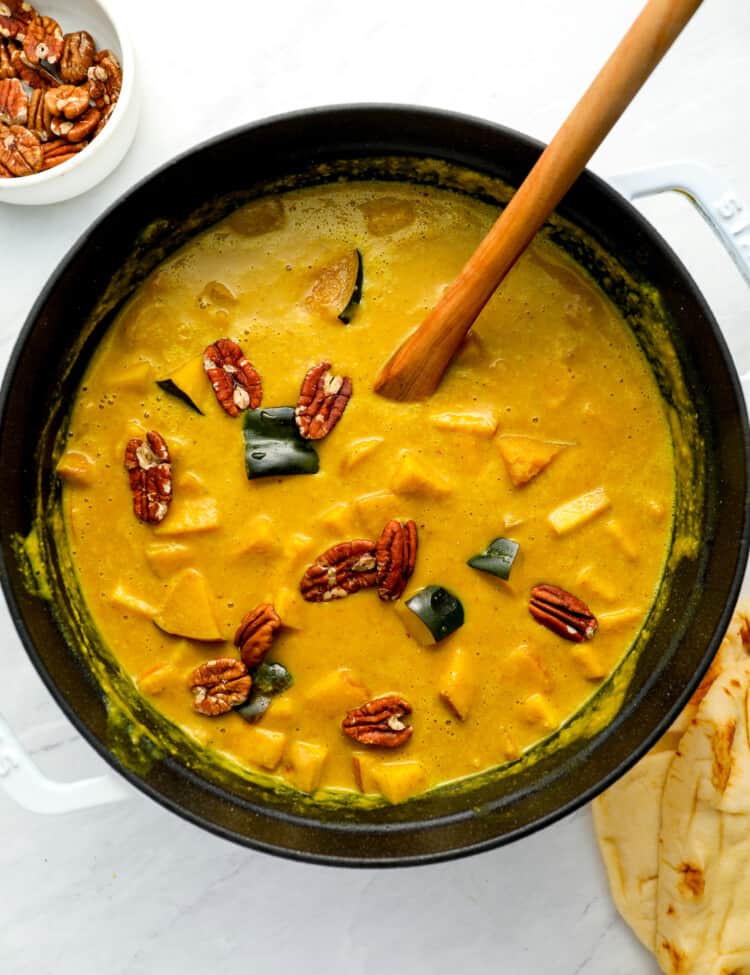
My acorn squash curry simmers tender squash in creamy coconut milk with ginger, garlic, and toasted coriander, cumin, fennel, and turmeric. Tamarind adds a touch of tang to cut through the sweetness. This one-pot dinner is ready in 30 minutes.

I love the contrast of sweet acorn squash against rich coconut milk, but during recipe testing, I found that the curry needed something to keep it from leaning too sweet. Tamarind was the answer. Its sharp, tangy flavor pulls everything back into balance and keeps the curry firmly on the savory side.
I build the spices from scratch here rather than reaching for curry powder or paste. Coriander, turmeric, cumin, and cayenne go in, along with ground fennel seed, which is the one spice I wouldn’t leave out. It has a subtle licorice flavor that works especially well with the sweetness of the squash. The tamarind comes as a sticky block that you soak in hot water and work apart with your fingers, and just two tablespoons is enough to balance the whole pot.
I leave the acorn squash unpeeled because I like how the slightly chewy skin contrasts with the soft flesh, though you can absolutely peel it if you prefer. At the end, I mash a few pieces of squash against the side of the pot to naturally thicken the curry without needing a blender. And if you want similar cozy curry flavors with less chopping, my coconut lentil curry is the one I make most often.
Chef’s tip: You can roast and eat the seeds inside an acorn squash just like you make roasted pumpkin seeds. They are great for snacking or sprinkling on top of this curry!
How to easily cut an acorn squash
Acorn squash is the hardest of the winter squashes to get through, and the ridges make it worse. Here’s how I do it without a fight.
- Soften it first. Pierce the squash a few times with a knife and microwave it for 3 to 4 minutes. It won’t cook, but the skin gives just enough to make the first cut far less frightening. If you’d rather not microwave, 10 minutes in a 400°F oven does the same thing.
- Cut off both ends. Slice a thin piece off the stem end and the base so the squash sits flat instead of rolling toward your fingers. This is the step that makes the biggest difference to safety.
- Stand it up and halve it. Set it on a cut end, put the tip of a large, heavy knife into the top, and press down using the heel of your hand rather than sawing. If it sticks, rock the blade rather than forcing it.
- Scoop the seeds. A metal spoon works better than a plastic one. Keep the seeds if you want to roast them.
- Cut with the ridges, not across them. Lay each half cut side down and slice down each valley between the ridges. You’ll end up with curved wedges that are easy to cube from there.
If it’s still more work than you want, pre-cut butternut squash from the produce section works in this recipe with no other changes. The pieces are denser, so give them an extra few minutes in the pot.
How to pick a good acorn squash
Look for one that’s heavy for its size, with dull, dark green skin and firm flesh.
Weight tells you the most. Pick up two squash of roughly the same size and take the heavier one. Heavier means more flesh and less hollow space inside.
Press it all over. It should feel solid everywhere, with no soft spots or give. Soft patches mean it’s past its best.
Look for dull skin, not shiny. A glossy sheen usually means it’s been waxed, which can hide its age. Dull, dark green skin with a patch of orange is what you want. An entirely orange squash is overripe and will taste stringy.
Check the stem. It should still be attached, dry, and firm. A missing or mushy stem is where rot starts.
Skip anything cut or cracked. Small surface scars are fine, but breaks in the skin let moisture in.
A good one will keep in a cool, dark spot for a month or more, so it’s worth buying a couple when you see them.
Acorn Squash Curry with Coconut Milk and Tamarind
Ingredients
- 2 tablespoons tamarind pulp
- 1 tablespoon avocado oil
- 1 medium yellow onion (minced)
- 2 inch piece of ginger (minced)
- 3 cloves garlic (minced)
- 2 teaspoons ground coriander
- 1 teaspoon EACH: ground turmeric, cumin, fennel, and cayenne
- 1 medium acorn squash (about 2 ½ lb cubed – see notes)
- 14 ounce can of coconut milk
- 2 cups stock or water
- 1 teaspoon sea salt
- Optional garnishes: cilantro, lime, chilis, a sprinkle of cayenne, pumpkin seeds
Instructions
- Place the tamarind pulp in a small bowl and add about a ¼ cup of hot tap water. Mash it with your fingers to loosen the tamarind, then set it aside while you cook the onions. When it is soft, remove any seeds.2 tablespoons tamarind pulp
- Heat the oil in a large pot over medium-high heat. Add the onion and cook, stirring occasionally, until soft, about 3-4 minutes. Add the ginger and garlic and cook for 1 minute. Add the coriander, turmeric, cumin, fennel, and cayenne, and let them toast for 1 minute.1 tablespoon avocado oil, 1 medium yellow onion, 2 inch piece of ginger, 3 cloves garlic, 2 teaspoons ground coriander, 1 teaspoon EACH: ground turmeric, cumin, fennel, and cayenne
- Add the acorn squash, coconut milk, stock or water, the soaked tamarind, and sea salt to the pot. Bring to a boil, then reduce the heat to low, cover the pot, and let it simmer gently until the squash is soft, about 20 minutes.1 medium acorn squash, 14 ounce can of coconut milk, 1 teaspoon sea salt, 2 cups stock or water
- Mash a little of the squash with a fork or wooden spoon to thicken the curry. Serve with rice and any or all of the toppings.Optional garnishes: cilantro, lime, chilis, a sprinkle of cayenne, pumpkin seeds
Nutrition
We have thoroughly tested this recipe for accuracy. However, individual results may vary. See our full recipe disclosure here.











I’ve made this recipe twice and have really loved it both times! I haven’t had tamarind either time so I just use a little lemon or lime at the end and a bit of jaggery for a little sweetness. I had no idea acorn squash were so delicious! Love the skin, I’ve found it gets soft in as little as 20 minutes. All in all excellent recipe so stoked to have it in my repertoire.
I’m so happy to hear you’ve made it more than once and loved it. Your tamarind swap with citrus and jaggery sounds like a perfect balance.
I was excited to see this recipe as I had just purchase an acorn squash and was looking for a new way to prepare it. Then I saw that the squash must be cut into cubes.
Acorn squash is very hard, so hard that I have given up even cutting it in half and instead I just bake it whole, scraping out the seeds once it is done. So when I saw the many multiple cuts required for this recipe I just gave up considering doing this recipe.
I’d love a tasty and unusual recipe for cooked acorn squash pulp, something like a curry. I’d bet this recipe is very delicious but making all those cuts would destroy my wrists.
If you find it tricky to cut acorn squash, you can substitute pre-cut cubes of butternut squash. Hope that helps!
Sooo yummy! What a cool way to use acorn squash and the seeds. The self-made ones complete the dish perfectly. Next time, I think I am going to add mushrooms and maybe chickpeas. What other veggie do you think might complement the squash well?
Tasty easy peasy Sunday Fall lunch! Enjoyed producing this fine soup. My additions were a slight increase in the amount of spices except for salt…which I used a salt replacement. My choice of squash was blue vintage Hubbard. Used the meaty pulp as well as exterior skin. I had in my freezer my homemade coconut milk and veggie broth on hand—both were a delicious enhancement! This recipe will grace our table again! Thank you for sharing the recipe.
Thanks for sharing this recipe! I tried this at Takoi in Detroit and keep craving it. They add sweet potatoes and sultana raisins with Thai basil. So good. Can I use green curry paste?
Oh I like the idea of adding raisins! Green curry paste will change the color, but it will still be delicious.
My new favorite recipe! I don’t cook a lot so I found this a little intimidating but it turned out perfectly. I’ll be making it again for sure. Do you know if I can feeeze it?
I’m so happy to hear that the recipe was a hit! And yes, it freezes beautifully!
Smells amazing, but should have trusted my instincts when I thought, “There’s no way an acorn squash skin will soften enough to eat”. Instead I had to eat around chunks of bark. I think it would be excellent with something like delicata squash though.
I always eat the skin of acorn squash. It is more firm than the soft insides, but I love the contrast. If it’s not for you, you can always peel the squash before using it in this recipe. 🙂
Are the spices meant to be powdered or whole?
Powdered!
Thanks for posting this, it helped me use acorn squash in curry. Too lazy, used paste and added broccoli and shallots. 🙂
You’re so welcome!
About the fennel… there’s the “root” fennel, the tops of the root (that look like dill) and then there’s fennel seed. Since the recipe calls for only a teaspoon, can I assume it requires the seed?
Can’t wait to try this in the fall!
Thanks!
Yes! That is what I meant. Fennel seeds. Ground if you have them. 🙂
Any substitutions for the tamarind pulp?
Tamarind is a tart tasting. I bet a squeeze of lime at the end would do the trick. 🙂
Love you new food blog Kristen! Will try out some of the recipes !
Hey Andy,
Thanks so much! Hope you’re doing great down in sunny Costa Rica!!
I will definetely try that one. Thanks for a detailed explanation =)
Awesome! No prob at all 🙂